


Page 20 - WAPTAG TIMES_9th Aug2024.indd
P. 20
WATER INNOVATIONS


        DUAL-POWERED WATER                                        BIHAR STUDENTS DEVELOP
        PURIFICATION DEVICE                                       mAGNETIC ARSENIC REmOVAL
        DEVELOPED FOR SUSTAINABLE                                 DEVICE FOR SAFE DRINKING
        AGRICULTURE                                               WATER

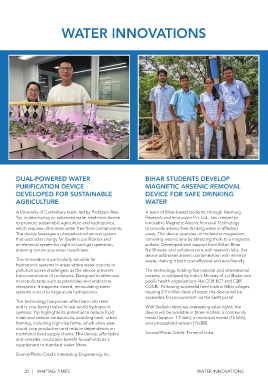
        A University of Canterbury team, led by Professor Alex    A team of bihar-based students, through Navmarg
        yip, is developing an advanced water treatment device     Research and Innovation Pvt. Ltd., has created an
        to promote sustainable agriculture and hydroponics,       innovative Magnetic Arsenic Removal Technology
        which requires ultra-clean water free from contaminants.   to provide arsenic-free drinking water in affected
        The device leverages a photoelectrochemical system        areas. The device operates on molecular magnetism,
        that uses solar energy for daytime purifi cation and      removing arsenic ions by attracting them to a magnetic
        an electrical system for night or low-light operation,    surface. Developed with support from Kilkari bihar
        ensuring continuous water cleanliness.                    bal bhawan and collaborations with research labs, this
                                                                  device addresses arsenic contamination with minimal
        This innovation is particularly valuable for              waste, making it both cost-effective and eco-friendly.
        hydroponic systems in areas where water scarcity or
        pollution poses challenges, as the device prevents        The technology, holding fi ve national and international
        bioaccumulation of pollutants. Designed to eliminate      patents, is validated by India's Ministry of Jal Shakti and
        micropollutants such as pesticides and endocrine          public health organizations like CSIR-IICT and CSIR-
        disruptors, it supports closed, recirculating water       CGCRI. Following successful fi eld trials in bihar villages,
        systems crucial to large-scale hydroponics.               treating 2.9 million liters of water, the device will be
                                                                  accessible for procurement via the GeM portal.
        The technology has proven effective in lab tests
        and is now being trialed in real-world hydroponic         With Stellarin Ventures overseeing sales rights, the
        systems. yip highlights its potential to reduce food      device will be available in three models: a community
        miles and carbon emissions by enabling local, urban       model (approx. 1.9 lakh), a municipal model (12 lakh),
        farming, including high-rise farms, which allow year-     and a household version (15,000).
        round crop production and reduce dependence on
        traditional food supply chains. The device, affordable    Source/Photo Credit: Times of India
        and versatile, could also benefi t households as a
        supplement to standard water fi lters.
        Source/Photo Credit: Interesting Engineering, Inc.


            20   |   WAPTAG TIMES                                                        WATER INNOVATIONS

